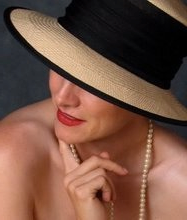
In fact, the eyebrow is the spokesperson for the face - particularly in women. Much of the time we have little control over the tiny muscles governing their spontaneous expression: arching in surprise, knitting together in concern, up and down in anger, irony, and joy. It's a large part of what makes the face, in both men and women, interesting.
From skinny to bushy, the brows tell of culture, fashion, and politics.
Robyn Cosio, author of The Eyebrow, argues that the story of the eyebrow's progress through
 the 20th century parallels the story of women's independence. The flapper era desexualized the newly liberated woman by taking away her hips, breasts, and eyebrows - penciling them back on thin and clueless through the 30s.
  Was the heavier, natural brow of the 40s and 50s a redefinition of femininity after the social upheaval of sex roles during the war years?
  The unkempt, even unruly, eyebrows of the 70s an encapsulation of the women's movement?
 The eyebrow of the new millennium is large again. Ladies, toss those tweezers! A whole bevy of Eastern European fashion models— Daris, Natalia, Vlada, Eugenia, Sasha and Snejana are inspiring a return to the bold brow. Last Fall, the NYTimes profiled stylists who declared “[o]n both coasts, everybody wants a thicker brow that reminds you of Elizabeth Taylor and Ava Gardner.” Styles may cycle in and out of favor, but many stars have made their mark with a face anchored by a prominent brow and, often, little else. It's a big statement. Strong eyebrows make one look intelligent and empowered.
 Nefertiti was a make-up queen when it came to her brows. She shaved them off and painted on those dramatic, elegant brows. Try to picture Audrey Hepburn without her brows, or Sophia Loren.
 Bette Davis wouldn't have made it past her screen test if the cinematographer Karl Freund hadn't convinced the director that she had "lovely eyes" and would be suitable for The Bad Sister (1931).
 Stars have completely changed their looks over the years by changing their eyebrows. Joan Crawford's incredibly thin blond brows of the 1920s evolved into her signature thick black brows of the 1950s. Look at how Madonna handles her eyebrows each time she reinvents her look.
 Getting the right brow isn't easy. There's actually a catelogue of celebrity browshapes to help you analyze what features appeal to you. Round brow? Julia Roberts. Arched? Think Keira Knightley. Softly angled? Nicole Kidman. Curvy? Kirstie Alley. Flat brows? Brooke Shields.
  Too much brow? A unibrow or monobrow, medically known as a synophrys, is fairly common in some ethnic groups. It's a sign of feminine beauty in Caucasus and Iran, where connected eyebrows are a sign of virginity and being unmarried. Salma Hayek has been quoted as saying she misses the days when she had one eyebrow because it would have come in handy for her role as Frida Kahlo, the legendary Mexican artist.
Less painful than tweezing or waxing, threading is a very trendy (and ancient) way of shaping the brow. Threading is widely used in India, the Middle East, China and Turkey on both men and women. (It is a Persian tradition to use threading to remove all of a bride's body hair before her wedding night in Iran.) Brad Pitt have been quoted in praise of eyebrow threading!
 Doing without eyebrows is quite altering. In Thomas Hardy's Tess of the d-Urbervilles, the beautiful heroine cuts off her eyebrows to protect herself from the lust of men. It is an effective subterfuge. Charlize Theron bravely shaved her eyebrows to better portray the title role in Monster (2003).
 Last month, da Vinci's iconic Mona Lisa was scanned using a high-definition camera. A 240-million pixel image using 13 light spectrums, including ultra-violet and infrared, reveals she probably once had eyelashes and eyebrows.
 Putting them back on is possible. Permanent makeup will last a number of years, but eventually the tattooing fades, a bit like disappearing ink. It's said that in the 1700s, English women wore falsies made out of tiny pieces of mouse fur. Today salons specializing in brows enhance very sparse ones by gluing a tiny fiber onto each existing hair, a form of eyebrow extensions. There are also brow prosthetics — little toupees for the hair-impaired — in a multitude of shapes and shades. Surgeons offer hair transplant techniques involving tiny hair grafts.
Gravity & aging cause the forehead tissue to sag downward, dropping the eyebrows from their youthful position to a lower position above the eye. It's generally perceived as an aged appearance– or tired, sad, or mad.
Time for a lift! If Botox chemical fix doesn't do it anymore, then it's time for surgery. In a direct browlift the incision is immediately above the brow in a forehead crease– this raises each brow but not the entire forehead (Sylvester Stallone). A temporal lift places a wedge excision in the hair for a lateral pull. A coronal lift puts the incision behind the hairline, excising a wedge of scalp and hoisting up the entire forehead including the eyebrows (Elizabeth Taylor). The least invasive, most natural look involves an endoscopic lift of the brow by re-suspension of the forehead muscles under the brows.
Interested in this look? Eyebrow extensions can cost between $75 to $250 and takes 45 minutes to two hours for an effect that lasts two weeks. Brow reconstruction with hair transplants by a physician involves 150 to 200 grafts for a complete male eyebrow or 100 to 150 grafts for a complete female eyebrow at $4-10/graft. A facial plastic surgeon might charge $3,900 to $5,900 for an endoscopic browlift.
Like the music we played on air?

Want to read more?


 Other forms of "moral turpitude" were concealed from the public.


 And breasts?